data("Wage")

wage_median <- median(Wage$wage, na.rm = TRUE)

Wage <- Wage %>%
  mutate(
    WageCategory = case_when(
      wage > wage_median ~ "High",
      wage < wage_median ~ "Low",
      TRUE ~ NA_character_
    )
  ) %>%
  filter(!is.na(WageCategory))

Wage$WageCategory <- factor(Wage$WageCategory, levels = c("Low", "High"))9 WagePredictors
9.1 Introduction
This analysis examines whether demographic characteristics, age, marital status, employment, and health variables can predict whether someone earns a comparatively higher or lower wage. A binary wage outcome was created based on the median wage. Classical statistical tests (t-tests, ANOVA, and chi-square) and a logistic regression model were used to identify meaningful predictors of income category.
Note
This chapter demonstrates combining classical hypothesis testing with predictive modeling (logistic regression) to examine wage differences.
9.2 Data Preparation
table(Wage$WageCategory) %>%
  as.data.frame() %>%
  knitr::kable() %>%
kableExtra::kable_styling(full_width = FALSE)| Var1 | Freq |
|---|---|
| Low | 1447 |
| High | 1483 |
9.3 Cleaning Factor Variables
clean_factor <- function(x) {
  x <- as.character(x)
  x <- str_replace(x, "^[0-9]+\\.\\s*", "")
  factor(x)
}

Wage <- Wage %>%
  mutate(
    race       = clean_factor(race),
    education  = clean_factor(education),
    jobclass   = clean_factor(jobclass),
    health     = clean_factor(health),
    health_ins = clean_factor(health_ins),
    maritl     = clean_factor(maritl)
  )
9.4 Age Differences (T-Test)
Wage %>%
  group_by(WageCategory) %>%
  summarise(
    mean_age = mean(age, na.rm = TRUE),
    sd_age   = sd(age, na.rm = TRUE),
    n        = n()
  ) %>%
  knitr::kable(digits = 2) %>%
kableExtra::kable_styling(full_width = FALSE)| WageCategory | mean_age | sd_age | n |
|---|---|---|---|
| Low | 40.01 | 12.67 | 1447 |
| High | 44.69 | 9.82 | 1483 |
age_ttest <- t.test(age ~ WageCategory, data = Wage)
age_ttest
    Welch Two Sample t-test

data:  age by WageCategory
t = -11.143, df = 2724.7, p-value < 2.2e-16
alternative hypothesis: true difference in means between group Low and group High is not equal to 0
95 percent confidence interval:
 -5.496555 -3.851525
sample estimates:
 mean in group Low mean in group High
          40.01106           44.68510
9.5 Interpretation
A Welch two-sample t-test showed a significant difference in age between high and low wage earners, t(2724.7) = −11.14, p < .001. High earners were, on average, older than low earners, indicating a positive association between age and wage.
9.6 Education and Wage (Anova)
wage_edu_aov <- aov(wage ~ education, data = Wage)

summary(wage_edu_aov)[[1]] %>%
  as.data.frame() %>%
  knitr::kable(digits = 2) %>%
kableExtra::kable_styling(full_width = FALSE)| Df | Sum Sq | Mean Sq | F value | Pr(>F) | |
|---|---|---|---|---|---|
| education | 4 | 1242703 | 310675.73 | 228.55 | 0 |
| Residuals | 2925 | 3976086 | 1359.35 | NA | NA |
9.7 Interpretation
The ANOVA showed a significant effect of education on wage, F(4, 2925) = 228.5, p < .001. Wages increased consistently with higher levels of education, suggesting that education is a strong predictor of income.
9.8 Marital Status and Wage (Chi-Square)
wage_maritl_table <- table(Wage$WageCategory, Wage$maritl)

wage_maritl_table %>%
  as.data.frame.matrix() %>%
  knitr::kable() %>%
kableExtra::kable_styling(full_width = FALSE)| Divorced | Married | Never Married | Separated | Widowed | |
|---|---|---|---|---|---|
| Low | 114 | 817 | 470 | 37 | 9 |
| High | 86 | 1202 | 169 | 18 | 8 |
chisq_wage_maritl <- chisq.test(wage_maritl_table)
chisq_wage_maritl
    Pearson's Chi-squared test

data:  wage_maritl_table
X-squared = 225.33, df = 4, p-value < 2.2e-16
cramer_v <- CramerV(wage_maritl_table)
cramer_v[1] 0.27731959.9 Interpretation
The chi-square test showed a significant association between wage category and marital status, χ²(4) = 225.33, p < .001. Cramer’s V = 0.277 indicates a moderate association. Married individuals were more represented in the high-wage group, while never-married individuals were more represented in the low-wage group.
9.10 Train Test Split
set.seed(123)
split_flag <- sample.split(Wage$WageCategory, SplitRatio = 0.7)

train_data <- subset(Wage, split_flag == TRUE)
test_data  <- subset(Wage, split_flag == FALSE)
9.11 Logistic Regression Model
logit_model <- glm(
  WageCategory ~ age + education + jobclass + maritl + health + health_ins,
  data = train_data,
  family = binomial
)

summary(logit_model)
Call:
glm(formula = WageCategory ~ age + education + jobclass + maritl +
    health + health_ins, family = binomial, data = train_data)

Coefficients:
                          Estimate Std. Error z value Pr(>|z|)
(Intercept)              -3.906039   0.410689  -9.511  < 2e-16 ***
age                       0.016967   0.005301   3.201  0.00137 **
educationAdvanced Degree  2.878189   0.272729  10.553  < 2e-16 ***
educationCollege Grad     2.356742   0.243963   9.660  < 2e-16 ***
educationHS Grad          0.654597   0.231391   2.829  0.00467 **
educationSome College     1.399887   0.238876   5.860 4.62e-09 ***
jobclassInformation       0.128700   0.110463   1.165  0.24398
maritlMarried             0.816820   0.209849   3.892 9.92e-05 ***
maritlNever Married      -0.480261   0.245800  -1.954  0.05072 .
maritlSeparated          -0.213755   0.474737  -0.450  0.65252
maritlWidowed             0.191127   0.599294   0.319  0.74979
health>=Very Good         0.325054   0.121269   2.680  0.00735 **
health_insYes             1.372473   0.123232  11.137  < 2e-16 ***
---
Signif. codes:  0 '***' 0.001 '**' 0.01 '*' 0.05 '.' 0.1 ' ' 1

(Dispersion parameter for binomial family taken to be 1)

    Null deviance: 2843.0  on 2050  degrees of freedom
Residual deviance: 2115.4  on 2038  degrees of freedom
AIC: 2141.4

Number of Fisher Scoring iterations: 4
odds_ratios <- exp(coef(logit_model))
odds_ratios (Intercept) age educationAdvanced Degree
0.02012005 1.01711169 17.78204218
educationCollege Grad educationHS Grad educationSome College
10.55650582 1.92436665 4.05474320
jobclassInformation maritlMarried maritlNever Married
1.13734877 2.26329134 0.61862205
maritlSeparated maritlWidowed health>=Very Good
0.80754605 1.21061266 1.38410575
health_insYes
3.94509346 9.12 Generate Predictions
test_probs <- predict(logit_model, newdata = test_data, type = "response")

test_pred_class <- ifelse(test_probs > 0.5, "High", "Low")
test_pred_class <- factor(test_pred_class, levels = c("Low", "High"))

conf_mat <- caret::confusionMatrix(
  data      = test_pred_class,
  reference = test_data$WageCategory,
  positive  = "High"
)
9.13 Model Performance
conf_mat$table %>%
  as.data.frame.matrix() %>%
  knitr::kable() %>%
kableExtra::kable_styling(full_width = FALSE)| Low | High | |
|---|---|---|
| Low | 304 | 119 |
| High | 130 | 326 |
9.14 Checking for Accuracy
conf_mat$overall %>%
  as.data.frame() %>%
  knitr::kable(digits = 3) %>%
kableExtra::kable_styling(full_width = FALSE)| . | |
|---|---|
| Accuracy | 0.717 |
| Kappa | 0.433 |
| AccuracyLower | 0.686 |
| AccuracyUpper | 0.746 |
| AccuracyNull | 0.506 |
| AccuracyPValue | 0.000 |
| McnemarPValue | 0.526 |
roc_obj <- roc(
  response = test_data$WageCategory,
  predictor = test_probs,
  levels = c("Low", "High")
)
Setting direction: controls < casesplot(roc_obj, main = "ROC Curve for WageCategory Model")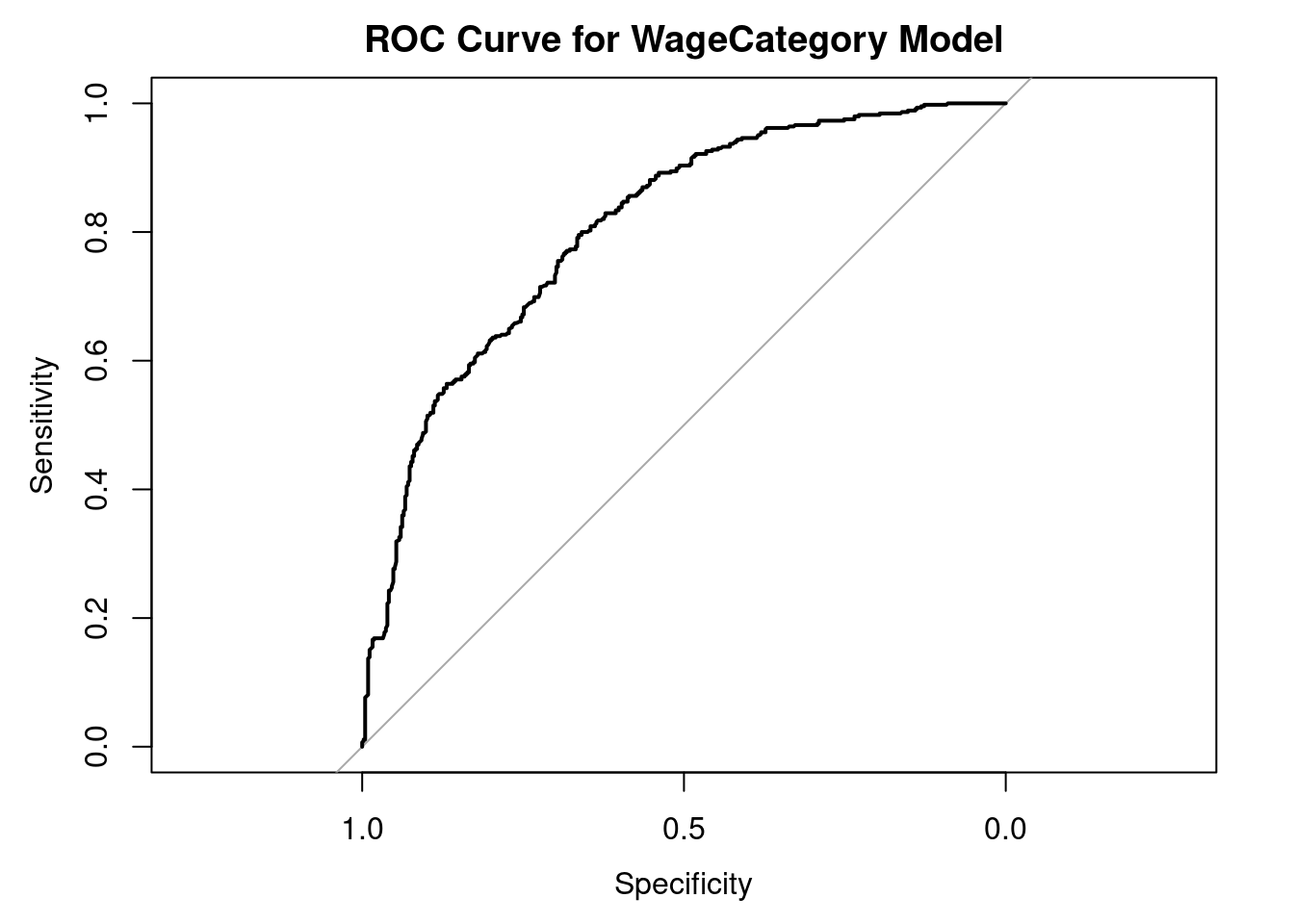
auc_value <- auc(roc_obj)
auc_value
Area under the curve: 0.80639.15 Conclusion
This analysis showed that high earners were older on average, and education had one of the strongest effects on wage. Income increased consistently with higher education levels. Married workers were more likely to be high earners, while never-married individuals were more often in the low-wage group.
The logistic regression model confirmed these patterns. Education emerged as the strongest predictor of high wage status. Age, marital status, health, and health insurance also contributed positively to the likelihood of earning a higher wage. The model achieved approximately 71.7% accuracy on the test set, indicating solid predictive performance.
Future analyses could incorporate additional life-course variables such as childhood socioeconomic status or family background to better understand long-term influences on adult income.