data <- read_excel("FloridaCountyCrimeRates.xlsx")

data <- data %>%
  rename(
    County = County,
    Crime = C,
    Income = I,
    HighSchoolGrad = HS,
    UrbanPop = U
  )

data$County <- str_to_title(tolower(data$County))7 FloridaCrime
7.1 Introduction
This chapter analyzes data from Florida counties to examine which factors—income, education, and urban environment—best predict county-level crime rates. Using descriptive statistics, visualizations, correlations, and regression models, I evaluate whether urban population, income, and high school graduation rates are associated with crime.
Note
This analysis focuses on relationships (correlations and regression). These results can suggest patterns, but they do not prove causation.
7.2 Data Import and Cleaning
head(data) %>%
  knitr::kable() %>%
kableExtra::kable_styling(full_width = FALSE)| County | Crime | Income | HighSchoolGrad | UrbanPop |
|---|---|---|---|---|
| Alachua | 104 | 22.1 | 82.7 | 73.2 |
| Baker | 20 | 25.8 | 64.1 | 21.5 |
| Bay | 64 | 24.7 | 74.7 | 85.0 |
| Bradford | 50 | 24.6 | 65.0 | 23.2 |
| Brevard | 64 | 30.5 | 82.3 | 91.9 |
| Broward | 94 | 30.6 | 76.8 | 98.9 |
7.3 Descriptive Statistics
psych::describe(data[, c("Crime", "Income", "HighSchoolGrad", "UrbanPop")]) %>%
  as.data.frame() %>%
  tibble::rownames_to_column(var = "Variable") %>%
  knitr::kable(digits = 2) %>%
kableExtra::kable_styling(full_width = FALSE)| Variable | vars | n | mean | sd | median | trimmed | mad | min | max | range | skew | kurtosis | se |
|---|---|---|---|---|---|---|---|---|---|---|---|---|---|
| Crime | 1 | 67 | 52.40 | 28.19 | 52.0 | 51.60 | 25.20 | 0.0 | 128.0 | 128.0 | 0.32 | -0.29 | 3.44 |
| Income | 2 | 67 | 24.51 | 4.68 | 24.6 | 24.33 | 5.34 | 15.4 | 35.6 | 20.2 | 0.34 | -0.70 | 0.57 |
| HighSchoolGrad | 3 | 67 | 69.49 | 8.86 | 69.0 | 69.48 | 11.56 | 54.5 | 84.9 | 30.4 | -0.02 | -1.30 | 1.08 |
| UrbanPop | 4 | 67 | 49.56 | 33.97 | 44.6 | 49.75 | 42.40 | 0.0 | 99.6 | 99.6 | -0.02 | -1.49 | 4.15 |
7.4 Visualization
ggplot(data, aes(x = Income, y = Crime)) +
  geom_point() +
  geom_smooth(method = "lm", se = TRUE) +
  theme_minimal() +
  labs(
    title = "Income vs Crime (Florida Counties)",
    x = "Income",
    y = "Crime"
  )
`geom_smooth()` using formula = 'y ~ x'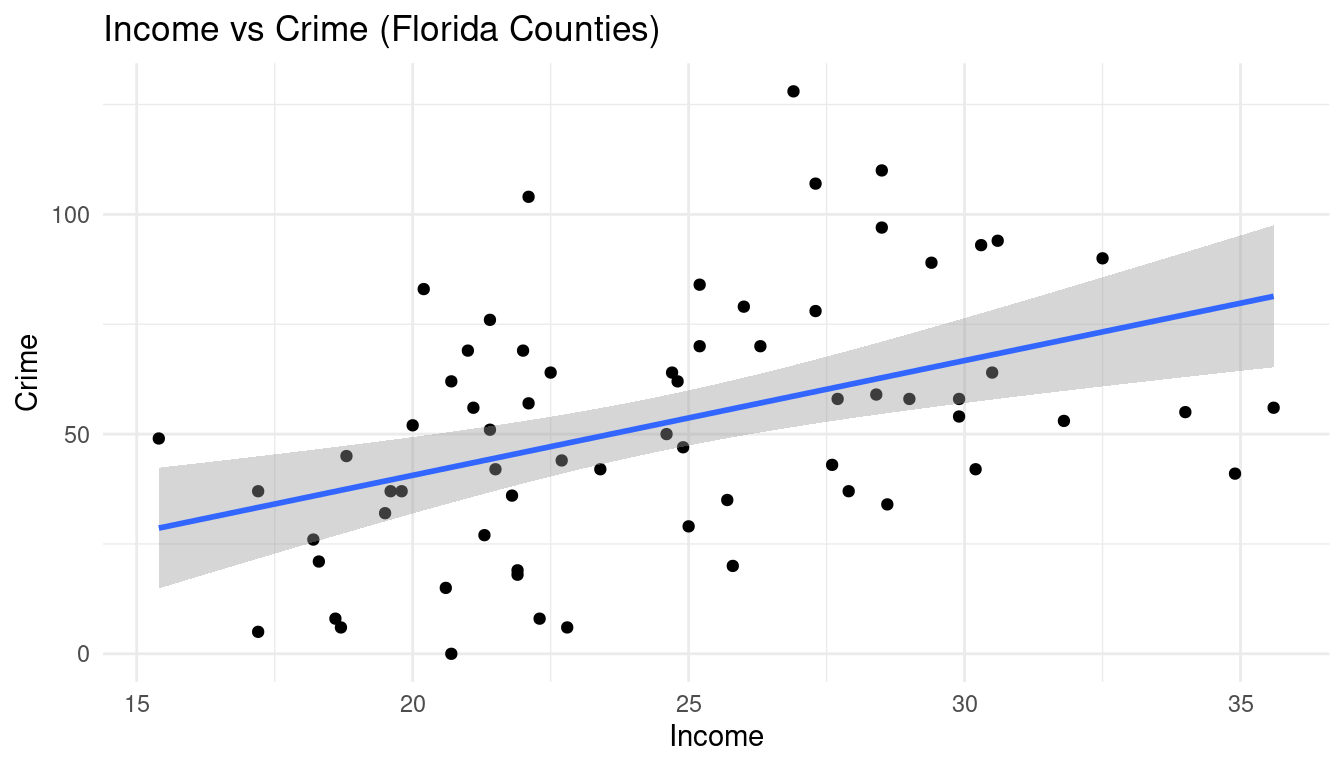
ggplot(data, aes(x = Crime)) +
  geom_histogram(bins = 20, fill = "skyblue", color = "white") +
  theme_minimal() +
  labs(
    title = "Distribution of Crime Rates (Florida Counties)",
    x = "Crime",
    y = "Number of Counties"
  )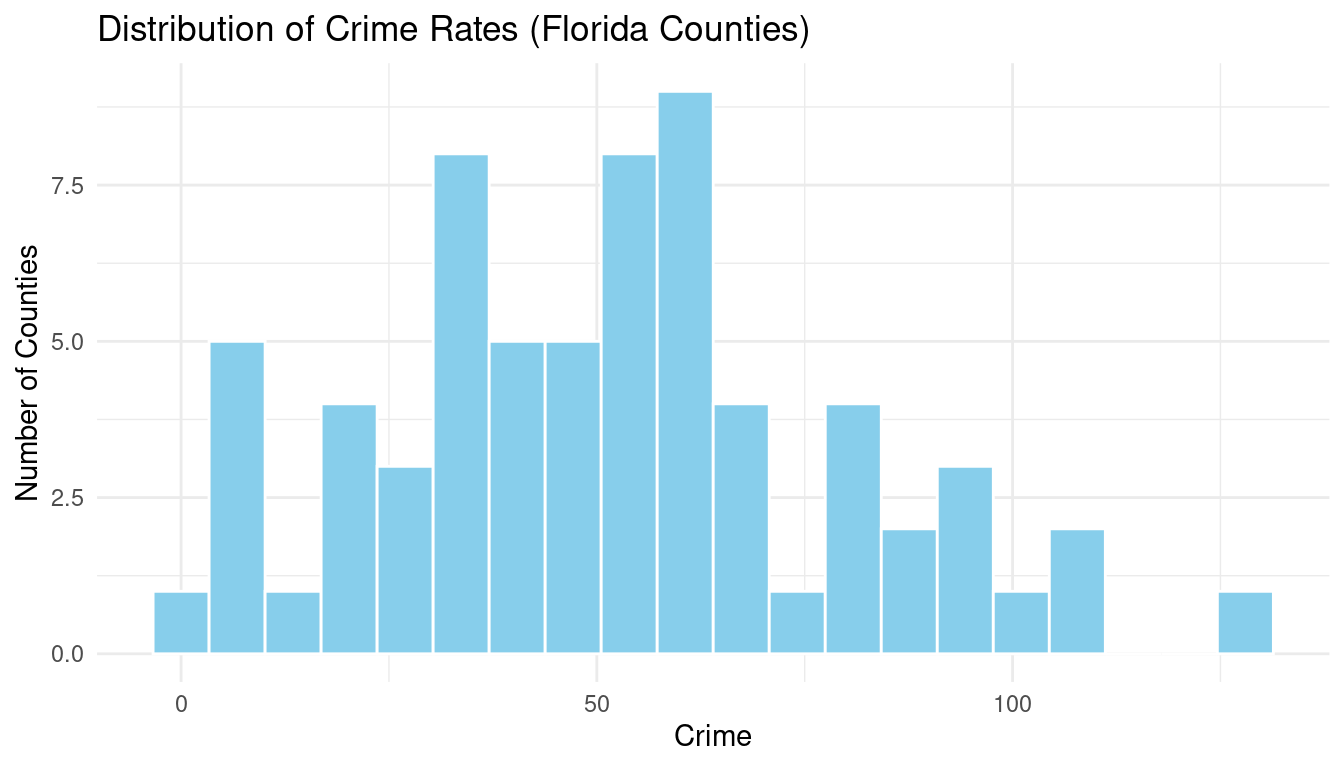
The scatterplot suggests a positive relationship between income and crime, meaning counties with higher income may also show somewhat higher crime rates. The histogram indicates that most counties cluster around moderate crime rates, with a smaller number of counties showing higher levels.
Tip
A positive relationship between income and crime can occur if higher-income counties are also more urban. Urbanization can act as a confounding variable, which is why multiple regression is useful.
7.5 Correlation Matrix
cor_matrix <- cor(
  data[, c("Crime", "Income", "HighSchoolGrad", "UrbanPop")],
  use = "pairwise.complete.obs"
)

ggcorrplot::ggcorrplot(cor_matrix, lab = TRUE, title = "Correlation Matrix")
Warning: `aes_string()` was deprecated in ggplot2 3.0.0.
ℹ Please use tidy evaluation idioms with `aes()`.
ℹ See also `vignette("ggplot2-in-packages")` for more information.
ℹ The deprecated feature was likely used in the ggcorrplot package.
Please report the issue at <https://github.com/kassambara/ggcorrplot/issues>.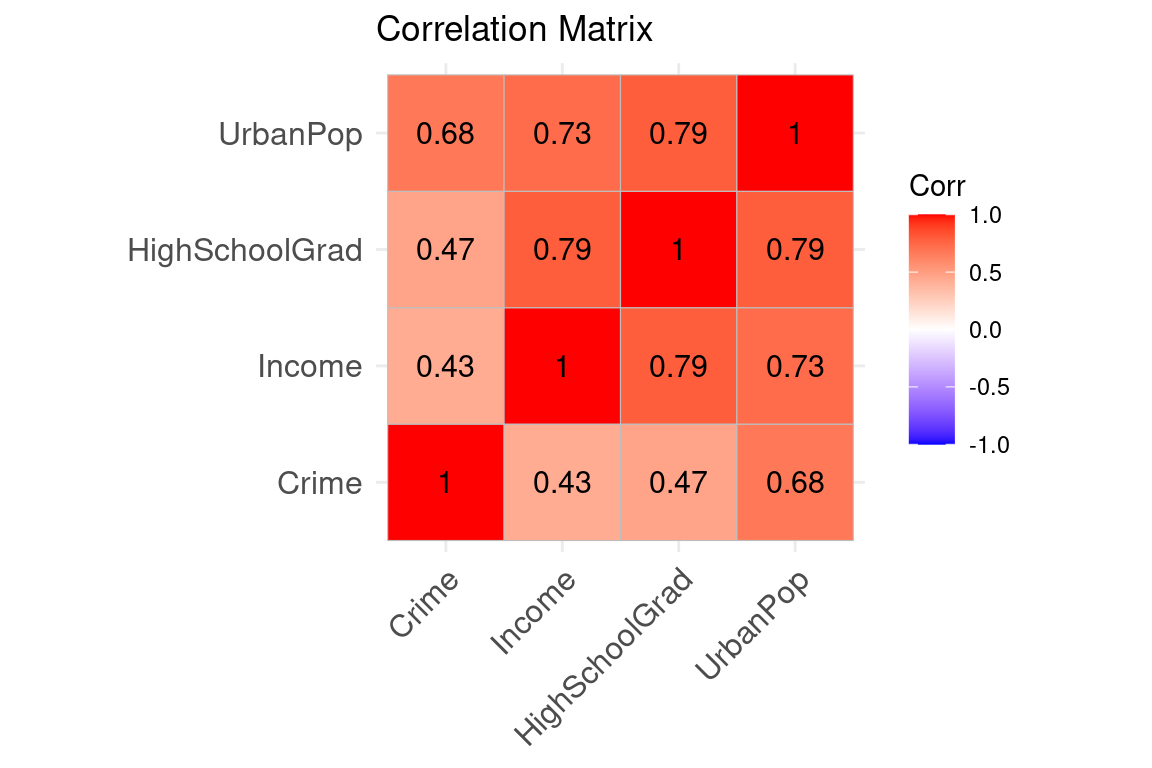
7.6 Regression Models
broom::tidy(m1) %>%
  knitr::kable(digits = 3) %>%
kableExtra::kable_styling(full_width = FALSE)| term | estimate | std.error | statistic | p.value |
|---|---|---|---|---|
| (Intercept) | -11.606 | 16.786 | -0.691 | 0.492 |
| Income | 2.611 | 0.673 | 3.881 | 0.000 |
broom::tidy(m2) %>%
  knitr::kable(digits = 3) %>%
kableExtra::kable_styling(full_width = FALSE)| term | estimate | std.error | statistic | p.value |
|---|---|---|---|---|
| (Intercept) | 59.715 | 28.590 | 2.089 | 0.041 |
| Income | -0.383 | 0.941 | -0.407 | 0.685 |
| HighSchoolGrad | -0.467 | 0.554 | -0.843 | 0.403 |
| UrbanPop | 0.697 | 0.129 | 5.399 | 0.000 |
bind_rows(
  broom::glance(m1) %>% mutate(Model = "Income only"),
  broom::glance(m2) %>% mutate(Model = "Multiple regression")
) %>%
  select(Model, r.squared, adj.r.squared, AIC, BIC, sigma) %>%
  knitr::kable(digits = 3) %>%
kableExtra::kable_styling(full_width = FALSE)| Model | r.squared | adj.r.squared | AIC | BIC | sigma |
|---|---|---|---|---|---|
| Income only | 0.188 | 0.176 | 628.605 | 635.219 | 25.598 |
| Multiple regression | 0.473 | 0.448 | 603.676 | 614.700 | 20.953 |
AIC(m1, m2) %>%
  as.data.frame() %>%
  tibble::rownames_to_column(var = "Model") %>%
  knitr::kable(digits = 2) %>%
kableExtra::kable_styling(full_width = FALSE)| Model | df | AIC |
|---|---|---|
| m1 | 3 | 628.60 |
| m2 | 5 | 603.68 |
7.7 Conclusion
The correlation matrix suggests crime is most strongly associated with urban population. Income and high school graduation also show associations with crime, but these relationships should be interpreted cautiously because they may reflect differences between urban and rural counties. In the multiple regression model, urban population remains the strongest predictor after accounting for income and education.
7.8 Memo to the Chief of the Florida Police Department
Based on this analysis, the multiple regression model provides the best prediction of Florida’s county-level crime rates. The results suggest that urbanization is the strongest and most consistent predictor of crime, meaning that counties with larger urban populations tend to experience higher crime rates. To reduce crime statewide, the Florida Police Department should prioritize resources and targeted interventions in highly urbanized counties.
Before implementing solutions, it would be valuable to identify which types of crimes are most common in high-crime urban areas. If crime is primarily driven by theft, vandalism, or assault, increasing patrol coverage and visible deterrence may help. However, if a substantial portion is linked to substance use, domestic violence, or mental health crises, then expanding partnerships with social services—such as mental health professionals and social workers—may be equally important. A balanced approach combining enforcement with prevention and community support is likely to be most effective in reducing crime in Florida’s urban counties.