file_path <- "midterm_sleep_exercise.xlsx"

# (Optional) quick check during development:
# readxl::excel_sheets(file_path)

participant_info <- readxl::read_xlsx(
  file_path,
  sheet = "participant_info_midterm"
)

sleep_data <- readxl::read_xlsx(
  file_path,
  sheet = "sleep_data_midterm"
)

participant_info <- janitor::clean_names(participant_info)
sleep_data <- janitor::clean_names(sleep_data)5 Sleep_and_Exercise_Analysis
5.1 Introduction
This chapter analyzes a dataset examining whether different exercise routines are associated with improvements in sleep. Using data cleaning, merging, descriptive statistics, visualizations, t-tests, and one-way ANOVA with post-hoc comparisons, I evaluate changes in sleep duration (post–pre) and sleep efficiency across exercise groups.
Note
This analysis demonstrates a complete reproducible workflow, including importing messy real-world data, cleaning variables, visualizing patterns, and performing statistical inference.
5.2 Data Cleaning and Preparation
merged_data <- left_join(participant_info, sleep_data, by = "id") %>%
  mutate(
    sex = case_when(
      tolower(sex) %in% c("female","fem","f","femalee") ~ "Female",
      tolower(sex) %in% c("male","mal","m","malee") ~ "Male",
      TRUE ~ NA_character_
    ),
    exercise_group = case_when(
      str_detect(tolower(exercise_group), "c\\+w|cw") ~ "C+W",
      str_detect(tolower(exercise_group), "cardio") ~ "Cardio",
      str_detect(tolower(exercise_group), "weights|weight") ~ "Weights",
      str_detect(tolower(exercise_group), "none") ~ "None",
      TRUE ~ exercise_group
    ),
    age = as.numeric(age),
    pre_sleep = as.numeric(str_extract(pre_sleep, "\\d+\\.\\d+")),
    post_sleep = as.numeric(post_sleep),
    sleep_difference = post_sleep - pre_sleep,
    agegroup2 = case_when(
      age < 40 ~ "<40",
      age >= 40 ~ ">=40",
      TRUE ~ NA_character_
    )
  ) %>%
filter(!is.na(sleep_difference))list(
exercise_group = table(merged_data$exercise_group),
sex = table(merged_data$sex),
agegroup2 = table(merged_data$agegroup2)
) %>%
knitr::kable()
|
|
|
5.3 Descriptive Statistics
overall_summary <- merged_data %>%
  summarise(
    mean_sleep_diff = mean(sleep_difference),
    sd_sleep_diff = sd(sleep_difference),
    min_sleep_diff = min(sleep_difference),
    max_sleep_diff = max(sleep_difference),
    mean_sleep_eff = mean(sleep_efficiency),
    sd_sleep_eff = sd(sleep_efficiency),
    min_sleep_eff = min(sleep_efficiency),
    max_sleep_eff = max(sleep_efficiency)
  )

knitr::kable(overall_summary, digits = 2)| mean_sleep_diff | sd_sleep_diff | min_sleep_diff | max_sleep_diff | mean_sleep_eff | sd_sleep_eff | min_sleep_eff | max_sleep_eff |
|---|---|---|---|---|---|---|---|
| 0.68 | 0.63 | -1.1 | 2 | 84.16 | 5.98 | 71.7 | 101.5 |
group_summary <- merged_data %>%
  group_by(exercise_group) %>%
  summarise(
    mean_sleep_diff = mean(sleep_difference),
    sd_sleep_diff = sd(sleep_difference),
    mean_sleep_eff = mean(sleep_efficiency),
    sd_sleep_eff = sd(sleep_efficiency),
    n = n()
  )

knitr::kable(group_summary, digits = 2)| exercise_group | mean_sleep_diff | sd_sleep_diff | mean_sleep_eff | sd_sleep_eff | n |
|---|---|---|---|---|---|
| C+W | 1.10 | 0.10 | 90.23 | 3.76 | 3 |
| Cardio | 0.97 | 0.44 | 86.56 | 5.94 | 34 |
| N | 0.30 | 0.85 | 81.30 | 0.28 | 2 |
| None | 0.09 | 0.64 | 81.37 | 6.10 | 15 |
| Weights | 0.61 | 0.60 | 81.43 | 3.92 | 19 |
5.4 Visualization of Sleep Outcomes
ggplot(merged_data, aes(x = exercise_group, y = sleep_difference, fill = exercise_group)) +
  geom_boxplot() +
  labs(
    title = "Sleep Improvement by Exercise Group",
    x = "Exercise Group",
    y = "Sleep Difference (Post - Pre)"
  ) +
  theme_minimal() +
  theme(legend.position = "none")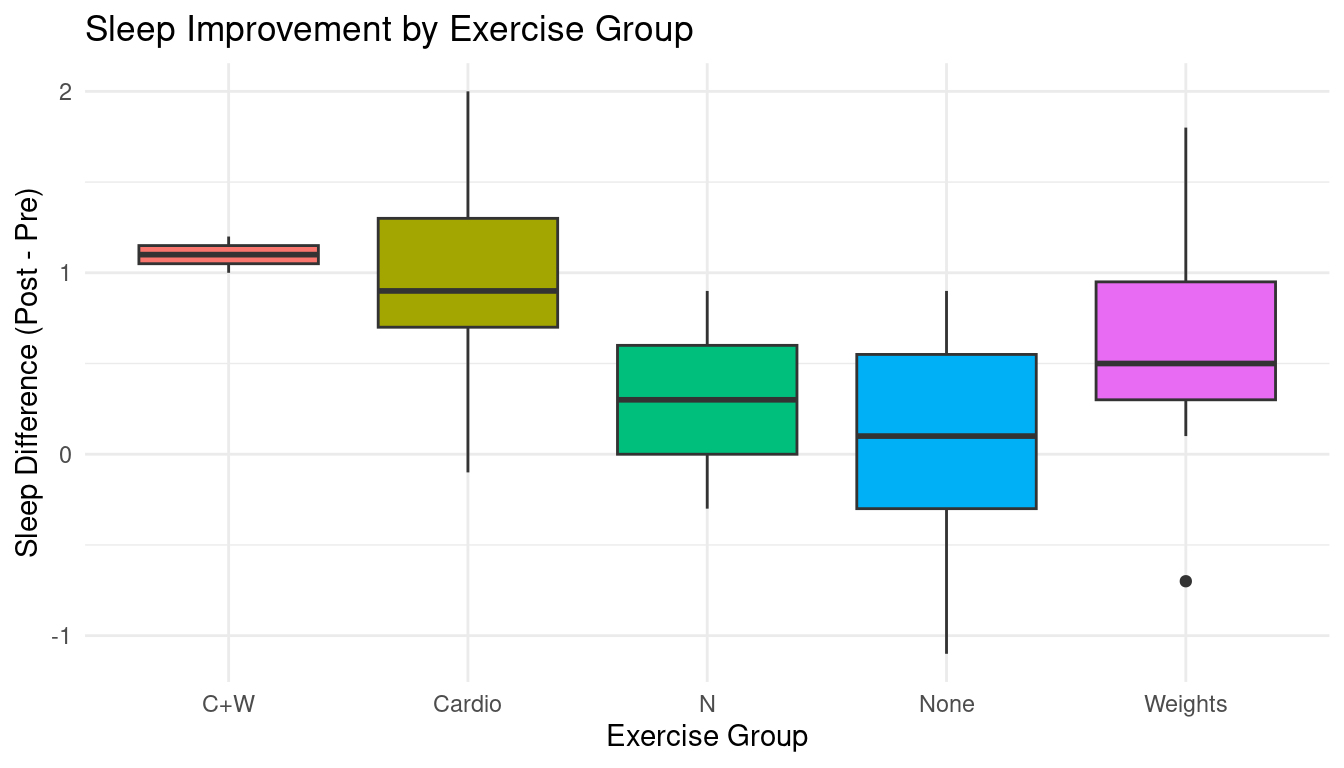
ggplot(merged_data, aes(x = exercise_group, y = sleep_efficiency, fill = exercise_group)) +
  geom_boxplot() +
  labs(
    title = "Sleep Efficiency by Exercise Group",
    x = "Exercise Group",
    y = "Sleep Efficiency (%)"
  ) +
  theme_minimal() +
  theme(legend.position = "none")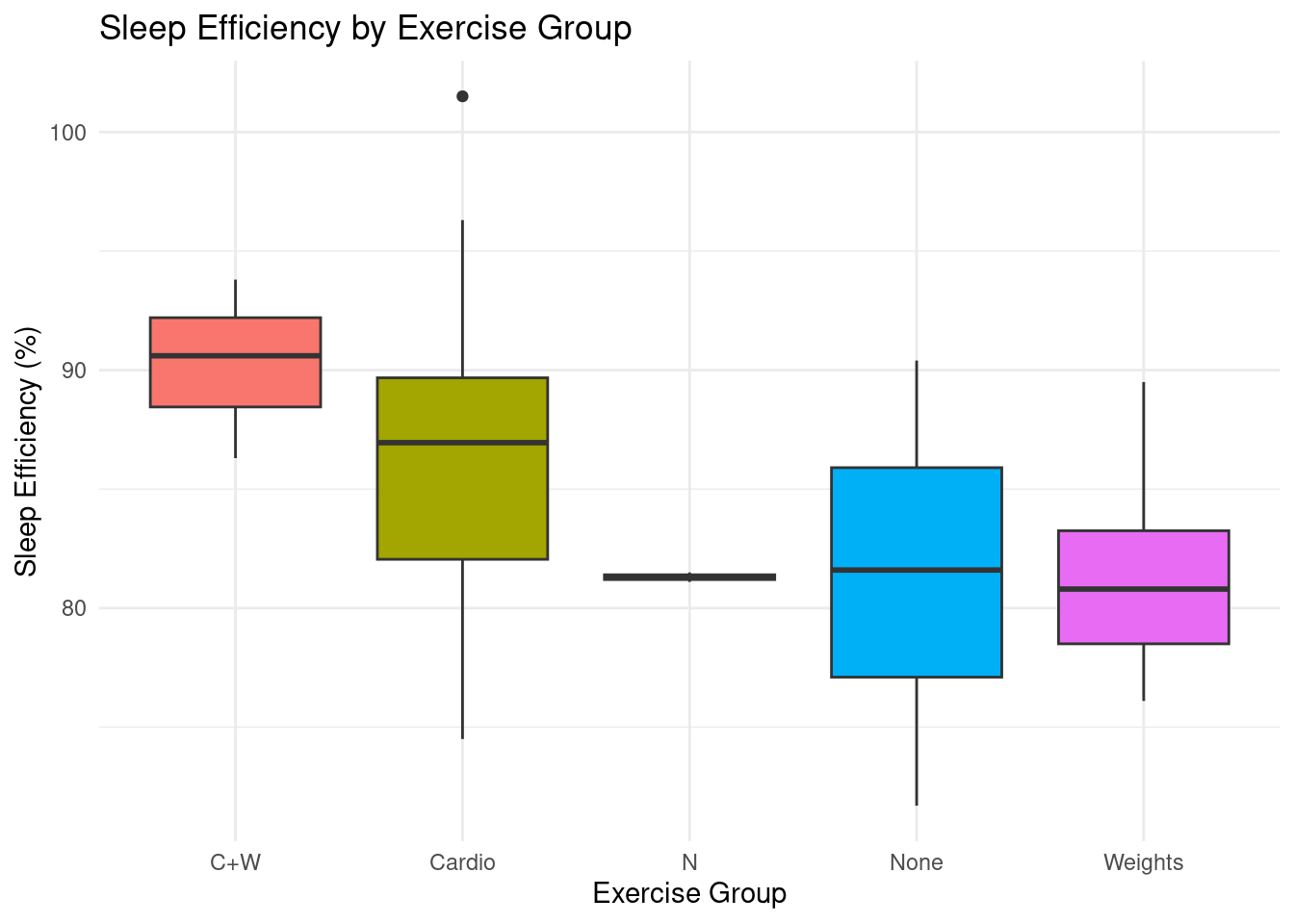
ggplot(merged_data, aes(x = sleep_difference, y = sleep_efficiency)) +
  geom_point(color = "blue") +
  geom_smooth(method = "lm", se = FALSE, color = "red") +
  labs(
    title = "Sleep Improvement vs Sleep Efficiency",
    x = "Sleep Difference",
    y = "Sleep Efficiency (%)"
  ) +
  theme_minimal()
`geom_smooth()` using formula = 'y ~ x'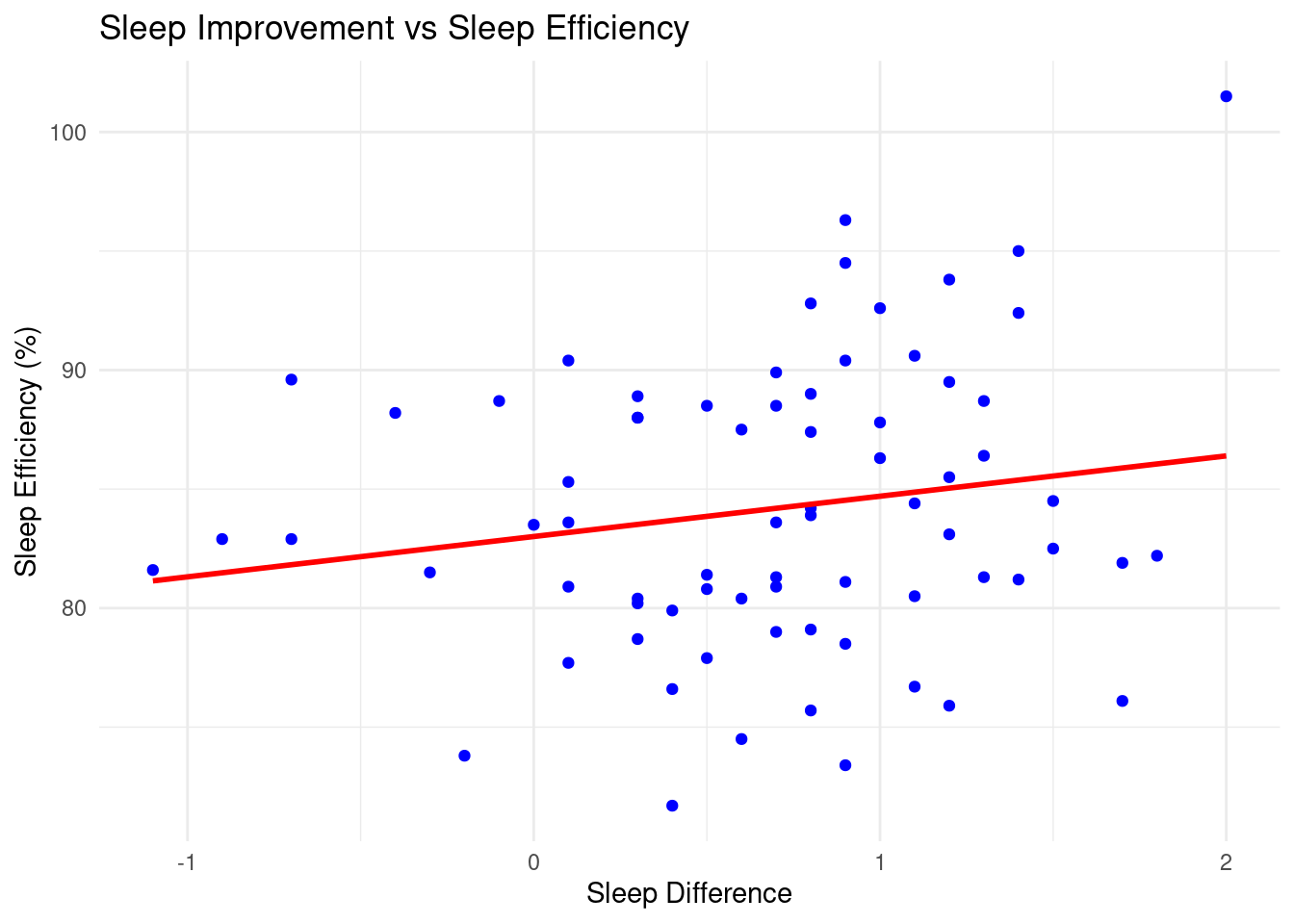
5.5 Independent Sample T-Test
t_sex <- t.test(
  sleep_difference ~ sex,
  data = merged_data %>% filter(!is.na(sex))
)

t_sex
    Welch Two Sample t-test

data:  sleep_difference by sex
t = 1.3852, df = 64.335, p-value = 0.1708
alternative hypothesis: true difference in means between group Female and group Male is not equal to 0
95 percent confidence interval:
 -0.09075179  0.50135785
sample estimates:
mean in group Female   mean in group Male
            0.775000             0.569697
t_age <- t.test(
sleep_difference ~ agegroup2,
data = merged_data %>% filter(!is.na(agegroup2))
)
t_age
    Welch Two Sample t-test

data:  sleep_difference by agegroup2
t = -1.357, df = 40.85, p-value = 0.1822
alternative hypothesis: true difference in means between group <40 and group >=40 is not equal to 0
95 percent confidence interval:
 -0.45511702  0.08932755
sample estimates:
 mean in group <40 mean in group >=40
         0.6421053          0.8250000
Tip
Neither sex nor age group showed statistically significant differences in sleep improvement, suggesting exercise effects are consistent across demographic groups.
5.6 One-way ANOVA and Post-hoc Comparisons
anova_sleep_diff <- aov(
  sleep_difference ~ exercise_group,
  data = merged_data
)

summary(anova_sleep_diff)
Df Sum Sq Mean Sq F value Pr(>F)
exercise_group 4 9.061 2.2653 8.02 2.34e-05 ***
Residuals 68 19.206 0.2824
---
Signif. codes: 0 '***' 0.001 '**' 0.01 '*' 0.05 '.' 0.1 ' ' 1eta_squared(anova_sleep_diff)For one-way between subjects designs, partial eta squared is equivalent
to eta squared. Returning eta squared.# Effect Size for ANOVA
Parameter | Eta2 | 95% CI
------------------------------------
exercise_group | 0.32 | [0.15, 1.00]
- One-sided CIs: upper bound fixed at [1.00].TukeyHSD(anova_sleep_diff) Tukey multiple comparisons of means
95% family-wise confidence level
Fit: aov(formula = sleep_difference ~ exercise_group, data = merged_data)
$exercise_group
diff lwr upr p adj
Cardio-C+W -0.1294118 -1.026386819 0.76756329 0.9942482
N-C+W -0.8000000 -2.159530534 0.55953053 0.4720308
None-C+W -1.0133333 -1.955243717 -0.07142295 0.0287638
Weights-C+W -0.4894737 -1.414711770 0.43576440 0.5772427
N-Cardio -0.6705882 -1.754206665 0.41303019 0.4203454
None-Cardio -0.8839216 -1.345549991 -0.42229315 0.0000102
Weights-Cardio -0.3600619 -0.786642681 0.06651884 0.1375430
None-N -0.2133333 -1.334430932 0.90776426 0.9835831
Weights-N 0.3105263 -0.796600673 1.41765330 0.9338316
Weights-None 0.5238596 0.009464793 1.03825451 0.0438730anova_sleep_eff <- aov(
sleep_efficiency ~ exercise_group,
data = merged_data
)
summary(anova_sleep_eff) Df Sum Sq Mean Sq F value Pr(>F)
exercise_group 4 580.7 145.2 4.954 0.00145 **
Residuals 68 1992.4 29.3
---
Signif. codes: 0 '***' 0.001 '**' 0.01 '*' 0.05 '.' 0.1 ' ' 1eta_squared(anova_sleep_eff)For one-way between subjects designs, partial eta squared is equivalent
to eta squared. Returning eta squared.# Effect Size for ANOVA
Parameter | Eta2 | 95% CI
------------------------------------
exercise_group | 0.23 | [0.07, 1.00]
- One-sided CIs: upper bound fixed at [1.00].TukeyHSD(anova_sleep_eff) Tukey multiple comparisons of means
95% family-wise confidence level
Fit: aov(formula = sleep_efficiency ~ exercise_group, data = merged_data)
$exercise_group
diff lwr upr p adj
Cardio-C+W -3.67745098 -12.813473 5.4585710 0.7912049
N-C+W -8.93333333 -22.780654 4.9139870 0.3775963
None-C+W -8.86666667 -18.460372 0.7270383 0.0835904
Weights-C+W -8.80175439 -18.225646 0.6221370 0.0784124
N-Cardio -5.25588235 -16.292936 5.7811713 0.6708789
None-Cardio -5.18921569 -9.891072 -0.4873598 0.0232689
Weights-Cardio -5.12430341 -9.469186 -0.7794209 0.0127670
None-N 0.06666667 -11.352126 11.4854595 1.0000000
Weights-N 0.13157895 -11.144918 11.4080760 0.9999997
Weights-None 0.06491228 -5.174389 5.3042138 0.99999975.7 Interpretation and Recommendations
Important
Exercise significantly improves both sleep duration and sleep efficiency. Cardio and combined cardio and weight training show the strongest benefits, while no exercise produces the smallest improvements.
Cardio-based exercise routines produced the largest sleep improvements and efficiency gains. Individuals who did not exercise showed the smallest improvements. These findings suggest that cardio or combined cardio and strength training may be the most effective exercise strategies for improving sleep.
5.8 Reflection
This analysis strengthened my ability to work with messy datasets, perform statistical analysis, and interpret results. I also improved my understanding of reproducible workflows and visualization techniques. Moving forward, I aim to continue improving my coding efficiency and statistical interpretation skills.